
Language:
Summit (Jinan) Energy Storage Development Co., Ltd
C&I Storage Engineering | Published: 2026-10-15 | Verified: 2026-10-15 | 7 min read

314Ah vs. 280Ah LiFePO4 Cells: Engineering, BOS Sizing & LCOS Guide for Modular BESS

Tier-1 lithium-ion cell manufacturers are phasing out legacy 280Ah lines in favor of 314Ah prismatic cells inside the exact same 71173207 mechanical housing. For solar EPCs and battery integrators building 32kWh to 256kWh modular storage banks, shifting from 14.33kWh to 16.08kWh cabinets directly alters rack count, DC busbar terminations, floor loading, and project LCOS.

SEL
Summit Engineering Lab Pack & BMS Architecture Team
Prismatic Cell Testing, Thermal Preload & Low-Voltage Microgrid Group
SECTION 01 / CELL ARCHITECTURE

Inside the 71173207 Prismatic Can: How 314Ah Replaces 280Ah Without Changing Dimensions

Between 2021 and 2024, the 280Ah prismatic $LiFePO4$ cell (71173207 format) defined standard modular battery sizing, delivering 14.33 kWh in a 16-series (51.2V) configuration. Starting in 2025–2026, major cell foundries consolidated their main stationary storage lines around the 314Ah prismatic cell.

What Changed Inside the Aluminum Housing?

The external aluminum casing remains strictly at 71.5 × 173.7 × 207.2 mm. The +12.1% energy increase (from 896.0 Wh to 1,004.8 Wh per cell) is achieved through higher $LiFePO4$ cathode compaction density, graded-porosity graphite anodes, thinner ceramic-coated separators, and flattened laser-welded current collector tabs that eliminate dead volume beneath the top cover plate.

For solar EPC contractors designing 32 kWh to 256 kWh commercial backup, agricultural microgrid, and peak-shaving battery banks, this cell upgrade means hitting target energy specifications with fewer cabinets, fewer DC breaker circuits, and lower shipping volume—while keeping existing 51.2V hybrid inverter models and rack footprints intact.
SECTION 02 / ELECTROCHEMICAL BENCHMARK

314Ah vs. 280Ah Technical Specification Matrix (16S 51.2V Configuration)

The table below compares verified Grade-A 280Ah cells against Grade-A 314Ah cells when integrated into a standard 16S1P (51.2V nominal) commercial battery cabinet:

Engineering Parameter 280Ah 16S System 314Ah 16S System Engineering Impact
Nominal Cell Capacity 280 Ah 314 Ah +12.1% Capacity per Cell
Nominal Cell Energy (3.2V) 896.0 Wh 1,004.8 Wh +108.8 Wh per Cell
Standard 16S1P Cabinet Energy 14.33 kWh (51.2V 280Ah) 16.08 kWh (51.2V 314Ah) +1.75 kWh per Cabinet
Prismatic Can Format (W x L x H) 71.5 x 173.7 x 207.2 mm 71.5 x 173.7 x 207.2 mm Identical 71173207 Shell
Volumetric Energy Density ~348 Wh/L ~390 Wh/L +12.1% Volumetric Density
1kHz AC Internal Resistance (ACIR) ~0.20 to 0.25 mOhm <= 0.18 mOhm ~20% Lower Ohmic Heating
16S Cabinet Net Weight (Approx.) ~126 kg (277 lbs) ~138 kg (304 lbs) +12 kg per Cabinet (+9.5%)
Cycle Life (80% DOD, 0.5C, 25 degC) 6,000 Cycles (to 70% SOH) 6,000 - 8,000 Cycles Slower First-Year SEI Loss
Cabinets Required for 256kWh Bank 18 Cabinets (257.9 kWh) 16 Cabinets (257.2 kWh) 2 Fewer Cabinets (-11.1%)
Levelized Cost of Storage (LCOS) ~$0.062 / kWh ~$0.048 / kWh ~22.5% LCOS Reduction
1kWh+ Single-Cell Milestone

At 3.2V × 314Ah = 1,004.8 Wh, each prismatic cell crosses the 1 kWh threshold, allowing a single 16S cabinet (such as the LPF-314AH) to deliver a true 16.08 kWh nameplate capacity.

First-Year SEI Stability

In addition to higher cycle counts, 314Ah electrolyte formulations reduce Solid Electrolyte Interphase (SEI) consumption during the first 200 cycles, keeping usable capacity higher in Years 1–3.

SECTION 03 / BALANCE OF SYSTEM (BOS)

Balance of System (BOS) Math: Sizing a 256kWh Commercial Bank

Evaluating battery packs solely on $/kWh cell price overlooks site-level installation realities. In modular 51.2V commercial projects, sheet-metal enclosures, 250A DC breakers, copper power leads, combiner busbars, and site labor account for 25% to 30% of turnkey hardware expenditure.

280Ah Bank Configuration 14.33kWh / Unit
Target Bank Capacity: 256.0 kWh
Required Cabinets: 18 Cabinets (257.9 kWh)
51.2V Power Cable Pairs: 18 Pairs (36 Heavy-Duty Leads)
BMS & Breaker Nodes: 18 BMS + 18x 250A MCCBs
Sub-Array Busbar Grouping: Requires 5 Busbar Groups (Uneven)
Est. BOS, Freight & Labor: $18,400
18 units exceed standard 16-address DIP switch limits, requiring an external master bridge.
314Ah Bank Configuration 16.08kWh / Unit
Target Bank Capacity: 256.0 kWh
Required Cabinets: 16 Cabinets (257.2 kWh)
51.2V Power Cable Pairs: 16 Pairs (32 Leads) - 4 Fewer Lugs
BMS & Breaker Nodes: 16 BMS + 16x 250A MCCBs
Sub-Array Busbar Grouping: 4 Symmetric Groups (4x 64.3kWh)
Est. BOS, Freight & Labor: $15,200 (Saves $3,200)
Fits native 16-unit BMS addressing without an external master controller.
INTERACTIVE SIZING TOOL

314Ah vs. 280Ah System BOS & Footprint Calculator

Slide to select your project's target storage capacity and compare the required cabinet count, heavy-duty 51.2V power cable terminations, floor area (including service clearance), and estimated BOS + freight + installation savings:

256 kWh
32 kWh (2 Cabinets) 128 kWh (8 Cabinets) 256 kWh (16 Cabinets) 512 kWh (Dual Bank)
Cabinets Saved
2 Units
16 vs 18 Cabinets
Power Leads Saved
4 Leads
2/0 AWG Copper Lugs
Floor Space Saved
1.2 sq.m
Incl. front service aisle
BOS & Freight Savings
$3,200
Enclosures, busbar & labor
Based on 16.08 kWh (314Ah) vs. 14.33 kWh (280Ah) 16S cabinets at $$1,600$ average turnkey BOS + freight delta per eliminated cabinet slot.
SECTION 04 / THERMAL & MECHANICAL ENGINEERING

ACIR Ohmic Heating & Cell Swelling Preload Inside 314Ah Packs

Packing 12.1% more active material into the same 71173207 aluminum can raises two critical engineering questions for battery pack designers: Does internal heat generation increase? And how is electrode expansion (swelling force) contained over 6,000+ cycles?

1. Lower Ohmic Loss via Multi-Tab Welding

Joule heating inside a prismatic cell during charge and discharge is governed by internal resistance:

Ploss = I2 × Rint

Because Grade-A 314Ah cells utilize widened full-tab current collectors and multi-point laser welding, 1 kHz AC Internal Resistance (ACIR) drops from ≈ 0.22 mΩ down to ≤ 0.18 mΩ. At a 150A continuous load (0.48C), each 16S cabinet generates ~18% less resistive heat than a legacy 280Ah pack, keeping terminal temperature rise within ΔT ≤ 12°C above ambient.

2. Mechanical Swelling Preload & Factory Sorting

Higher anode compaction increases lithium intercalation expansion force at 100% SOC. Unconstrained cells suffer electrolyte delamination and rapid capacity fade after 1,500 cycles. Inside the LPF-314AH cabinet, every 16S module is built with:

  • 3,000 N Steel End-Plate Preload: Welded structural cages maintain uniform compression across the cell face throughout its lifecycle.
  • 3 mm Ceramic-Aerogel Barriers: Inter-cell thermal pads block cell-to-cell thermal propagation and absorb breathing expansion.
  • 5-Point Factory Grading: Cells are matched prior to laser welding with ΔV ≤ 2 mV and ΔACIR ≤ 0.03 mΩ.
  • 2 mm Laser-Welded Aluminum Busbars: Equipped with expansion-relief arches to prevent terminal stud shear stress.
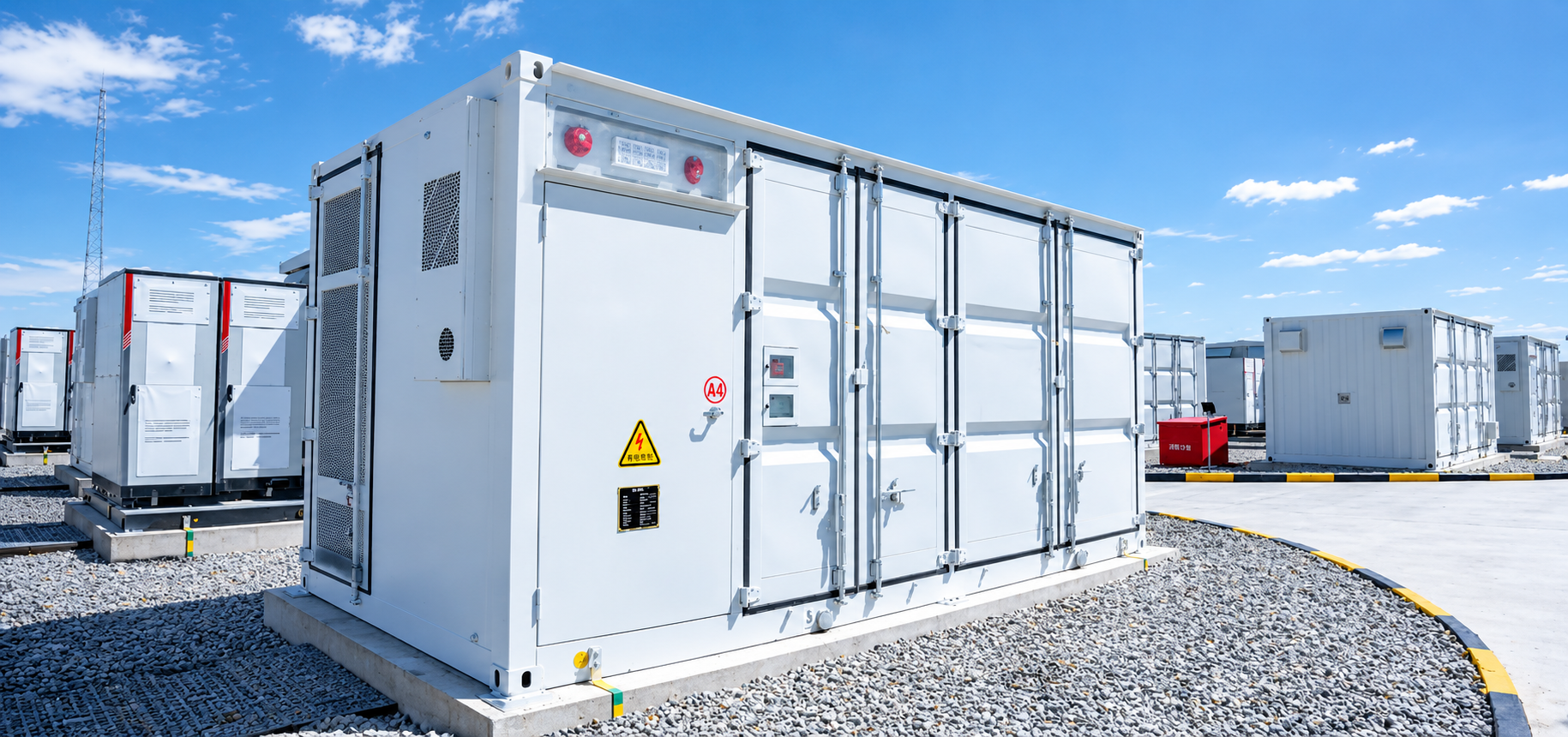
Modular 51.2V 314Ah Commercial Energy Storage Installation
Fig 4.1: Modular commercial BESS installation featuring compression-framed 314Ah cabinets and multi-point NTC terminal monitoring.
SECTION 05 / FINANCIAL METRICS

Levelized Cost of Storage (LCOS) and Commercial ROI Analysis

For commercial project developers, the definitive financial benchmark is the Levelized Cost of Storage (LCOS)—measuring total capital and operational cost per usable kilowatt-hour discharged over the system's operational lifetime:

LCOS = [ CAPEXCells + BOS + Labor + ∑ OPEX ] / ∑ Discharged Energy (kWh over Lifecycle)
Financial & Lifecycle Metric (256kWh Bank) 280Ah System (18 Cabinets) 314Ah System (16 Cabinets)
Pack Hardware Cost ($/kWh Baseline) 100% Baseline ~4% Lower $/kWh (Fewer Enclosures/BMS)
BOS, Racking, Cabling & Freight Cost $18,400 (18 Slots) $15,200 (16 Slots — Saves $3,200)
Warranted Cycle Life (80% DOD, 70% EOL) 6,000 Cycles 6,000 - 7,000+ Cycles (Higher Retention)
Cumulative Lifetime Energy Throughput ~1,045 MWh ~1,234 MWh (+18.1% Usable Yield)
Calculated Levelized Cost of Storage (LCOS) $0.062 / kWh $0.048 / kWh (-22.5%)
Simple Payback Period (TOU Arbitrage + Solar) 3.4 Years 2.7 Years (~8.5 Months Faster)

*Model assumes $0.18/kWh peak-to-off-peak commercial Time-of-Use (TOU) spread, 330 operating days/year at 80% DOD, and 94.5% DC round-trip efficiency. Run your facility's local utility tariff in our Commercial BESS ROI Calculator.

SECTION 06 / SYSTEM TOPOLOGY

51.2V Modular Sub-Array Architecture: Scaling from 16kWh to 256kWh Safely

For light commercial, agricultural, and off-grid industrial facilities between 32 kWh and 256 kWh, 51.2V modular parallel systems eliminate the arc-flash hazards, specialized high-voltage lockout certifications, and series-string imbalance downtime associated with 800V+ HV battery racks.

01 / NATIVE 16-UNIT ADDRESSING

Auto-Sync BMS Network

A 16-cabinet 314Ah bank reaches 257.2 kWh within a single 16-node RS485/CAN daisy chain—whereas a 280Ah bank requires 18 cabinets and an external master combiner hub.

02 / N+1 FAULT TOLERANCE

Hot-Isolatable Breakers

Each LPF-314AH houses an independent 250A DC molded-case circuit breaker (MCCB). Any single cabinet can be isolated for inspection while the remaining 15 cabinets stay online.

03 / PLUG-AND-PLAY PCS

Pre-Mapped CAN Protocols

Direct closed-loop BMS handshaking with Deye, Victron, Solis, Growatt, and GoodWe low-voltage hybrid inverters. View pinouts in our Inverter Protocol Guide.

SECTION 07 / FIELD COMMISSIONING

EPC Field Checklist: Deploying & Upgrading to 314Ah Cabinets

ENGINEERING RULE: Never Parallel 280Ah and 314Ah Cabinets on the Same DC Busbar

Even though both cabinets share a 51.2V nominal voltage, their internal resistance (≤ 0.18 mΩ vs. ≈ 0.22 mΩ) and dynamic polarization curves differ. Under high-load step changes, the lower-impedance 314Ah cabinets will absorb disproportionate surge currents, triggering BMS over-current protection and inducing cross-cabinet circulation currents during rest periods. If expanding an existing 280Ah site, connect the new 314Ah bank to a separate hybrid inverter MPPT/battery channel.

Pre-Commissioning Electrical & Mechanical Checklist:

  • 1 Use 4-Cabinet Sub-Array Busbars (Avoid Mega-Current Single Busbars): Do not land 16 low-voltage cabinets onto a single massive 2,500A busbar. Instead, divide a 16-cabinet (257.2 kWh) bank into 4 symmetric sub-arrays of 4 cabinets (64.3 kWh each). Terminate each 4-cabinet group onto a dedicated 600A – 800A tinned-copper combiner busbar feeding its own hybrid inverter unit.
  • 2 Symmetrical Cable Impedance: Cut positive and negative DC branch cables from each cabinet to the sub-array combiner bar to strictly identical lengths (±2 cm tolerance) using 2/0 AWG (70 mm²) fine-stranded copper cable, and torque M8/M10 busbar bolts to 12–15 N·m.
  • 3 Floor Slab Loading & Mechanical Positioning: A 16.08 kWh 314Ah cabinet weighs approximately 138 kg (304 lbs)—about 12 kg heavier than a 280Ah equivalent. Verify concrete floor load ratings (>350 kg/m² recommended for multi-cabinet rows) and engage the integrated seismic wall-anchor brackets after leveling the heavy-duty casters.
  • 4 Inverter Charge Voltage & Capacity Calibration: Verify that the hybrid inverter reads the aggregated BMS capacity (314Ah × N units, or 5,024 Ah for 16 units) over CAN. Set bulk/absorption charge voltage to 56.0V – 56.8V (3.50V – 3.55V/cell) and float voltage to 54.0V (3.375V/cell).
SECTION 08 / TECHNICAL FAQ

Frequently Asked Engineering Questions: 314Ah vs. 280Ah BESS

Q1: Can 314Ah and 280Ah 51.2V battery cabinets be paralleled on the same DC busbar?

No. Paralleling 314Ah (16.08kWh) and 280Ah (14.33kWh) cabinets on a shared 51.2V DC busbar is strictly prohibited. Because 314Ah cells exhibit ~20% lower internal resistance (ACIR <= 0.18 mOhm vs. ~0.22 mOhm) and a slightly different open-circuit voltage (OCV) plateau during high-load transitions, parallel operation causes uneven current sharing (current hogging), cross-cabinet circulation currents, and premature BMS over-current trips.

Q2: How do cell manufacturers fit 314Ah into the exact same 71x173x207 mm housing as 280Ah?

Both cells share the standard 71173207 aluminum prismatic shell (71.5 x 173.7 x 207.2 mm). The 12.1% capacity gain (1,004.8Wh vs. 896.0Wh) is achieved by increasing cathode active material compaction density, utilizing graded-porosity graphite anodes, reducing separator thickness with high-strength ceramic coatings, and optimizing internal tab laser welding to maximize active jelly-roll volume.

Q3: Does upgrading from 280Ah to 314Ah cabinets require changing 48V/51.2V hybrid inverters?

No hardware changes are required. A 16S 314Ah pack operates at the same 51.2V nominal voltage (44.8V to 57.6V operating window) as a 16S 280Ah pack. Standard low-voltage hybrid inverters (Deye, Victron, Solis, Growatt, GoodWe) communicate via standard CAN bus or RS485 protocols. During commissioning, installers simply verify that the inverter recognizes the updated 314Ah per-module capacity register.

Q4: How does the real-world cycle life of Grade-A 314Ah compare to 280Ah cells?

While standard Grade-A 280Ah cells are rated for 6,000 cycles to 70% State of Health (SOH), next-generation Grade-A 314Ah cells incorporate slow-degradation SEI film additives and pre-lithiation buffer technologies. Under standard 0.5C/0.5C cycling at 25 degC and 80% Depth of Discharge (DOD), 314Ah cells achieve 6,000 to 8,000+ cycles, significantly reducing early-stage lithium inventory loss during the first 365 cycles.

Q5: What is the recommended busbar architecture for a 16-cabinet (256kWh) 51.2V system?

Rather than landing all 16 cabinets onto a single massive busbar, best engineering practice divides the 16 cabinets into 4 sub-arrays of 4 cabinets (64.3kWh per group). Each 4-cabinet sub-array connects via equal-length 2/0 AWG (70 sq.mm) cables to a dedicated 600A-800A copper combiner busbar paired with its own hybrid inverter (PCS) unit, minimizing line losses and eliminating single-point bottlenecks.

Factory-Direct BESS Engineering

Standardize Your 2026 Projects on Grade-A 314Ah Architecture

Whether you require container-load wholesale pricing, OEM/ODM cabinet branding, or project-specific single-line diagrams (SLD) with matched hybrid inverters, our engineering team responds within 12 business hours.

View LPF-314AH Datasheet Speak with an Application Engineer